Care homes require particularly careful water-safety management because residents may be more susceptible to Legionnaires’ disease due to age, illness or reduced immunity. The challenge is not only to control Legionella risk, but also to manage other hazards such as scalding without creating conditions that allow bacteria to grow in the wider hot-water system.
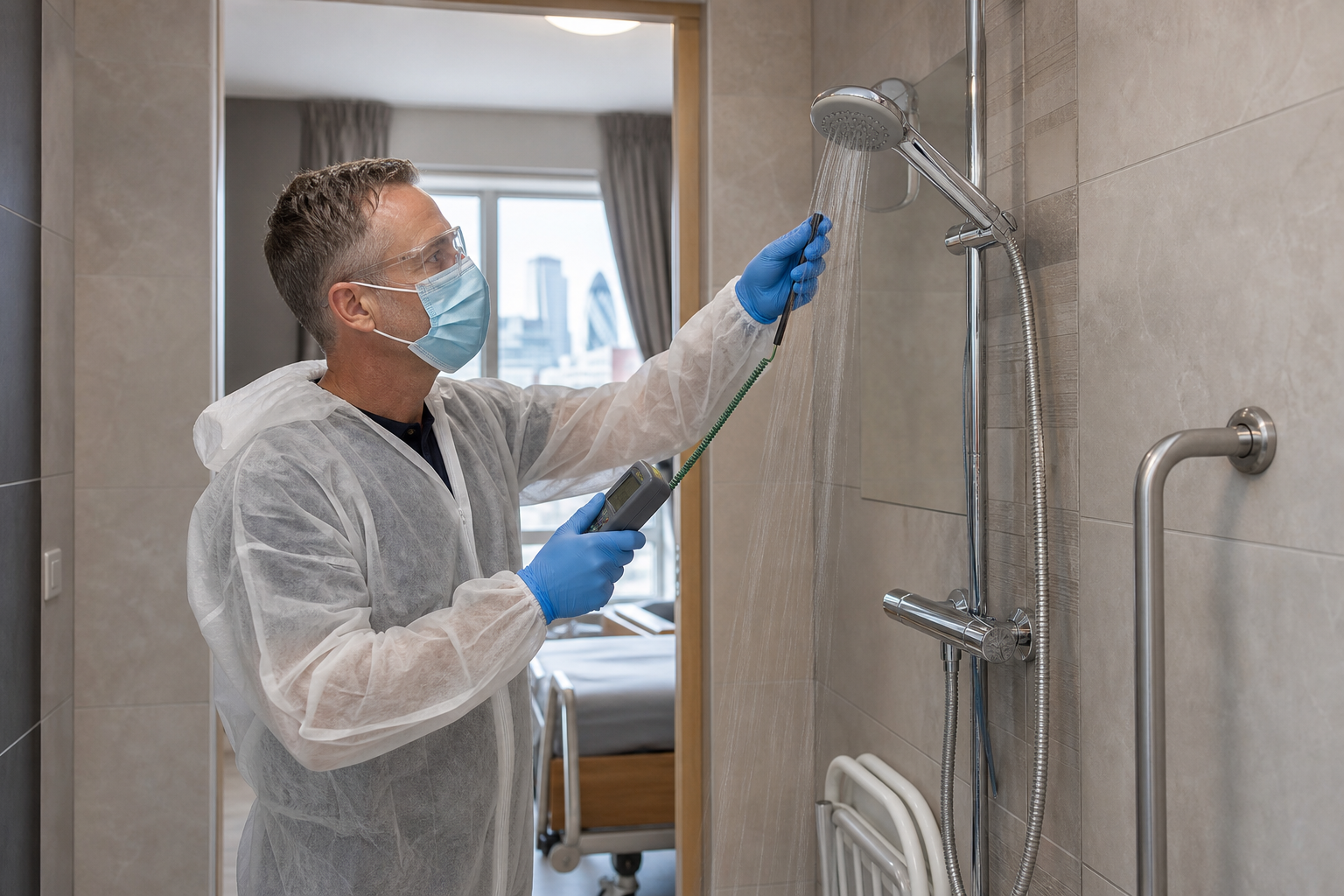
Why care homes need a stronger water-safety focus
HSE specifically notes that healthcare and care-home populations can include people at higher risk. Showers, taps and other outlets can create fine droplets that may be inhaled, so an effective control programme needs to address the whole hot and cold water system rather than relying on visual cleanliness alone.
Key controls for a London care home
- Maintain a current risk assessment. It should reflect the actual building, water system, resident population and operating arrangements.
- Nominate competent responsibility. Duties for monitoring, corrective action and record keeping should be clearly assigned.
- Control system temperatures. HSE guidance uses temperature as a primary control method for many hot and cold water systems. Where thermostatic mixing valves are used to reduce scald risk at outlets, the wider system still needs appropriate Legionella controls.
- Manage little-used outlets. Spare bedrooms, treatment rooms or bathrooms that are used infrequently need to be identified and included in the control scheme.
- Clean and descale showerheads and hoses. Maintenance frequency should follow the risk assessment and written control scheme.
- Inspect storage and distribution systems. Tanks, calorifiers, return loops, pipework condition and signs of stagnation all matter.
- Investigate control failures. Repeated temperature failures or inconsistent monitoring should trigger action, not simply another entry in the logbook.
Legionella control and scalding risk
Care settings often need thermostatic mixing valves because vulnerable residents may be at risk from hot water. A common mistake is to reduce the temperature of the entire hot-water system to solve a scalding concern. The safer approach is to manage scalding close to the point of use where appropriate while maintaining the wider system in accordance with the water-safety plan and HSE guidance.
Should care homes carry out Legionella sampling?
Sampling can form part of the control strategy in higher-risk systems and settings, but the programme should be determined by risk assessment and competent advice. A laboratory result is only one piece of evidence; it does not replace effective system design, temperature control, maintenance, cleaning, flushing and record keeping.
What should trigger a review?
Review the risk assessment when the building, water system or resident population changes, after significant refurbishment, after prolonged low occupancy, when monitoring shows repeated failures, or when there is another reason to believe the existing assessment is no longer valid.
If your care home has stored cold water, our guide to cold-water storage tanks and Legionella risk explains additional points to check.
Official guidance: Health and Safety Executive (HSE) L8 Approved Code of Practice and HSG274 Part 2.
London care-home assessment support: London Legionella Water Survey can carry out site-specific risk assessments and help care-home managers understand where practical controls and monitoring are required.