School buildings can experience sharp changes in water use during summer holidays, half-term breaks and other closures. When taps, showers and other outlets are used less frequently, sections of a hot and cold water system can become stagnant. For London schools with older buildings, extended pipe runs, sports facilities or several blocks, that reduced use can make a planned water-safety review especially important before normal occupancy resumes.
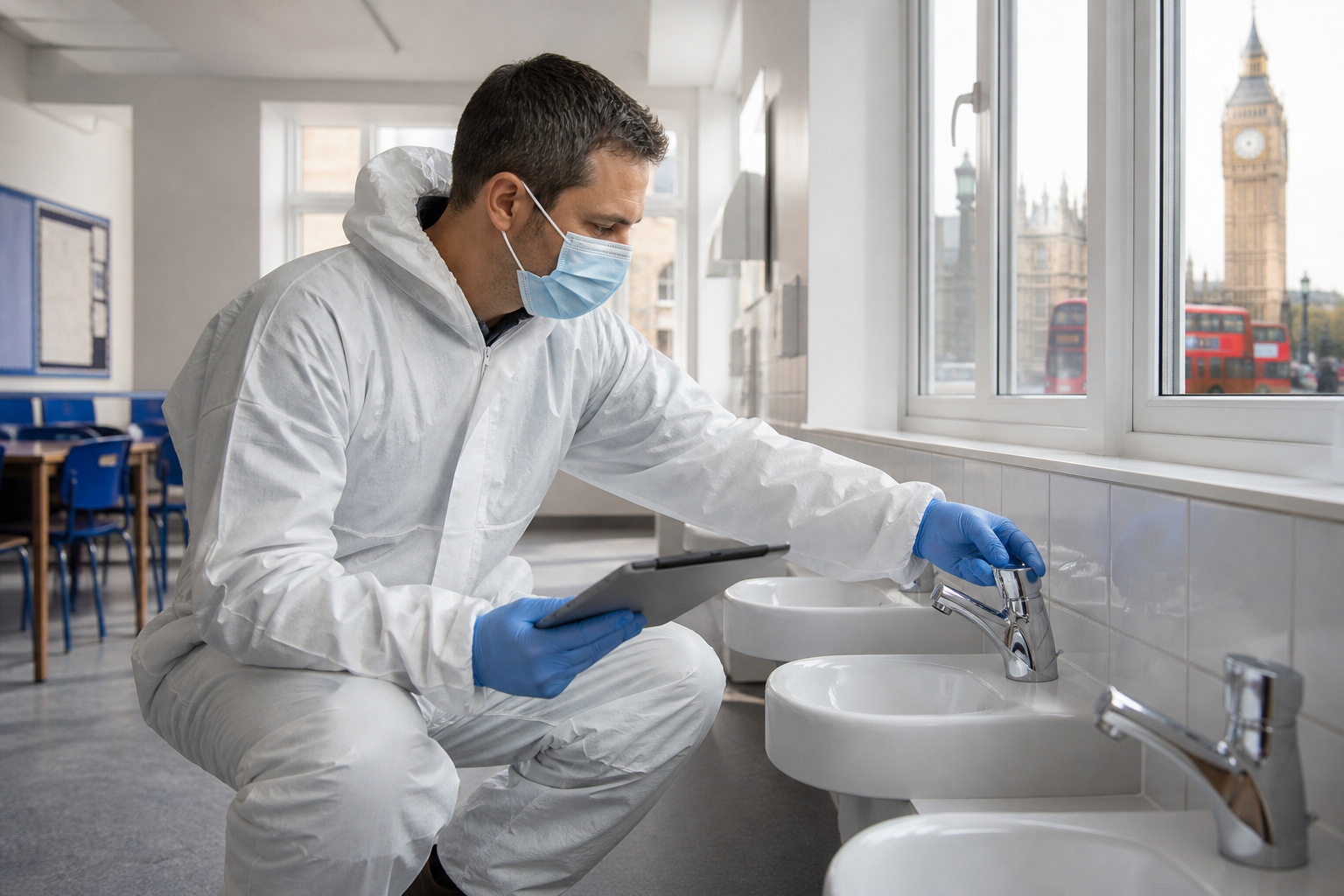
Why holiday closures can change Legionella risk
Legionella risk is influenced by several factors, including water stagnation, temperatures that support bacterial growth, scale or sediment, and outlets capable of producing aerosols. A school that is low risk during term time may not behave in exactly the same way when whole wings, changing rooms or teaching blocks are unused for several weeks.
HSE guidance emphasises that water systems should be assessed and that controls should reflect the actual system and its use. Reopening should therefore be based on a site-specific plan rather than a generic assumption that simply running every tap once will resolve all issues.
Pre-reopening checklist for estates teams
- Review the existing Legionella risk assessment. Check whether occupancy patterns, plumbing, storage tanks, calorifiers or outlet use have changed since the last assessment.
- Identify little-used outlets. Pay particular attention to showers, changing rooms, science areas, kitchens, staff facilities and remote washrooms.
- Check the flushing regime. Where flushing forms part of the control scheme, it should be carried out safely, consistently and in a way that avoids unnecessary aerosol exposure.
- Verify temperature controls. Confirm that the hot and cold water system is operating within the control parameters specified by the building’s risk assessment and written scheme.
- Inspect showerheads and hoses. Scale, deposits and poor maintenance can undermine otherwise suitable controls.
- Check storage and plant. Where the school has cold-water storage tanks or central hot-water plant, inspect the relevant components and records rather than focusing only on taps.
- Record the work. Reopening checks should be documented so the responsible person can demonstrate what was done and identify recurring failures.
Does a school automatically need Legionella testing after every holiday?
No. Microbiological sampling is not a substitute for risk assessment and control. Whether sampling is appropriate depends on the system, the risk profile, previous results, control failures and the advice of a competent person. The aim is not to order tests by default; it is to understand whether the system is being controlled effectively.
When should the risk assessment be reviewed?
A review is particularly sensible after significant plumbing alterations, new buildings or extensions, changes in water use, prolonged closure, repeated temperature failures or evidence that the existing control scheme is not working as intended.
Schools with several buildings should also avoid treating every outlet as identical. A frequently used washroom beside reception may present a very different pattern from a shower block that is only used during sports activities.
Planning ahead for the next closure
The most effective approach is to include holiday periods in the school’s normal water-safety management plan. That means identifying which outlets are likely to become little used, deciding in advance how they will be managed, allocating responsibility and keeping appropriate records.
For related guidance on stagnation, see our article on Legionella in empty properties before reoccupation.
Official guidance: Health and Safety Executive (HSE) L8 Approved Code of Practice and HSG274 Part 2.
Need a site-specific review? London Legionella Water Survey can assess hot and cold water systems in London education properties and help identify proportionate control measures based on the actual building and its use.