Hybrid working has changed water-use patterns in many London offices. A building may be technically occupied every weekday while entire floors, shower facilities, tea points or secondary washrooms receive very little use. That matters because stagnant water is one of the conditions that can increase Legionella risk.
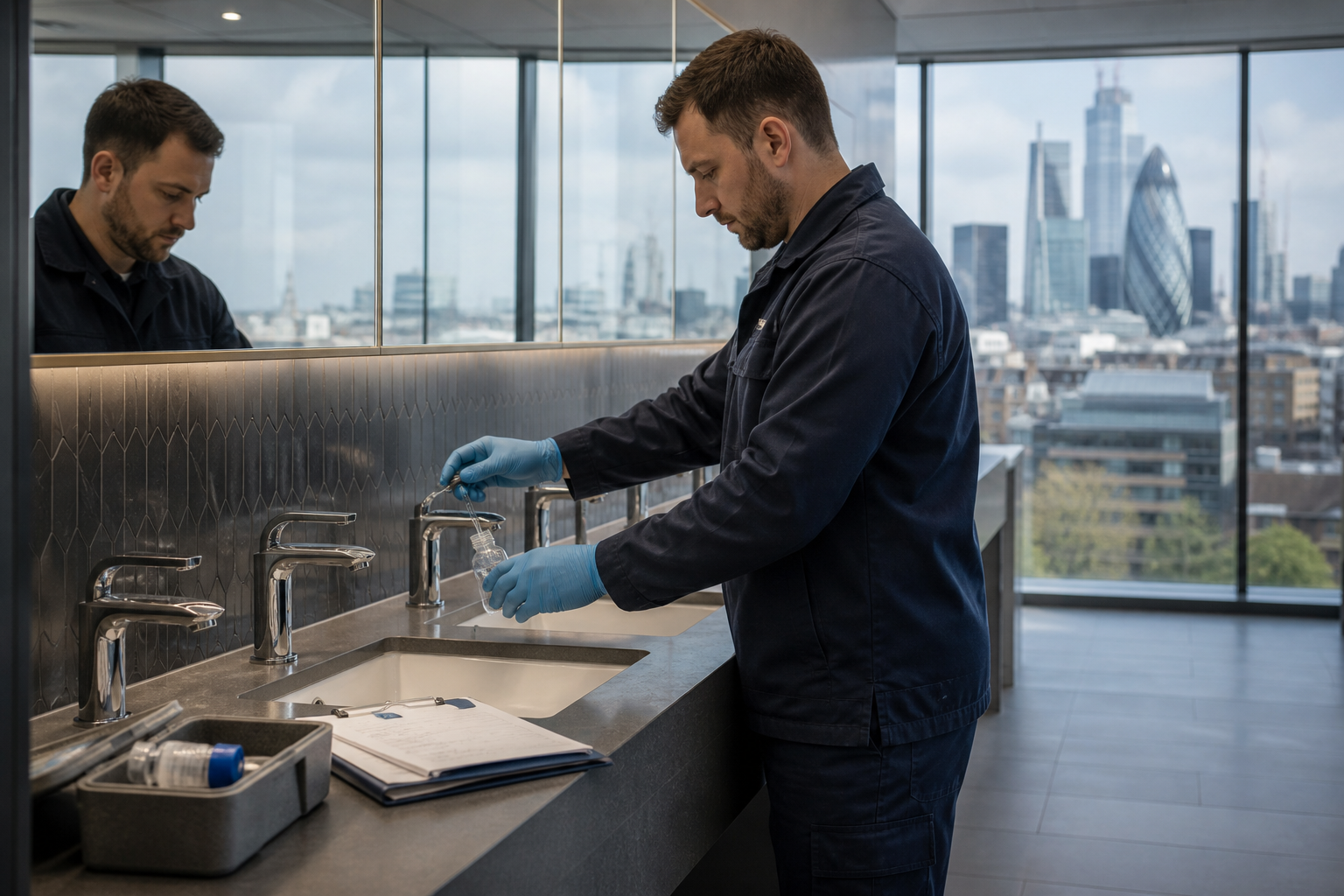
Why occupancy data matters
A conventional risk assessment may assume that office outlets are used regularly. After a move to hybrid working, that assumption can become inaccurate. A washroom beside the main reception may have high turnover, while a shower on a lightly occupied floor may remain unused for days.
The practical question for facilities managers is therefore not simply, “Is the building open?” It is, “Which parts of the water system are actually being used?”
Where to look for little-used outlets
- Showers and changing facilities used mainly by cyclists or gym users.
- Kitchenettes on floors with low occupancy.
- Accessible toilets or satellite washrooms that see infrequent use.
- Vacant tenant areas awaiting a new lease.
- Meeting suites, training floors or event spaces used only occasionally.
- Outlets left behind after office reconfiguration.
How should little-used outlets be managed?
HSE guidance identifies regular flushing of infrequently used outlets as one of the measures that can help control stagnation. The flushing programme should be based on the risk assessment, carried out safely and recorded. Where outlets are permanently redundant, removal of unnecessary pipework may be a better long-term solution than maintaining an indefinite flushing regime.
Do not ignore the system behind the tap
Outlet use is only part of the picture. Office buildings may also have cold-water storage, boosted systems, calorifiers, recirculating hot-water loops, expansion vessels and thermostatic mixing valves. The control scheme should consider these components and verify that temperatures and water turnover remain appropriate.
Can technology help?
Remote temperature and outlet-use monitoring can provide useful data in some larger or more complex buildings. HSE notes that some remote systems can help identify infrequently used outlets. Technology, however, should support a competent water-safety programme rather than replace inspection, maintenance or professional judgement.
When hybrid working should trigger a new review
A change in occupancy does not automatically mean the entire system is unsafe, but it can invalidate assumptions in an older assessment. A review is sensible where occupancy has fallen substantially, parts of the building are mothballed, tenants have moved, floor layouts have changed or persistent low-use areas have developed.
For a broader commercial-property checklist, read Legionella Risk in London Commercial Buildings.
Official guidance: Health and Safety Executive (HSE) L8 Approved Code of Practice and HSG274 Part 2.
Need help mapping the risk? London Legionella Water Survey can assess London office water systems, identify little-used outlets and help facilities teams determine proportionate controls.