Thermostatic mixing valves (TMVs) are widely used in care homes, schools, gyms, healthcare settings and other buildings where controlling the temperature at the outlet helps reduce scalding risk. They are useful safety devices, but they do not remove the need to control Legionella within the wider hot and cold water system.
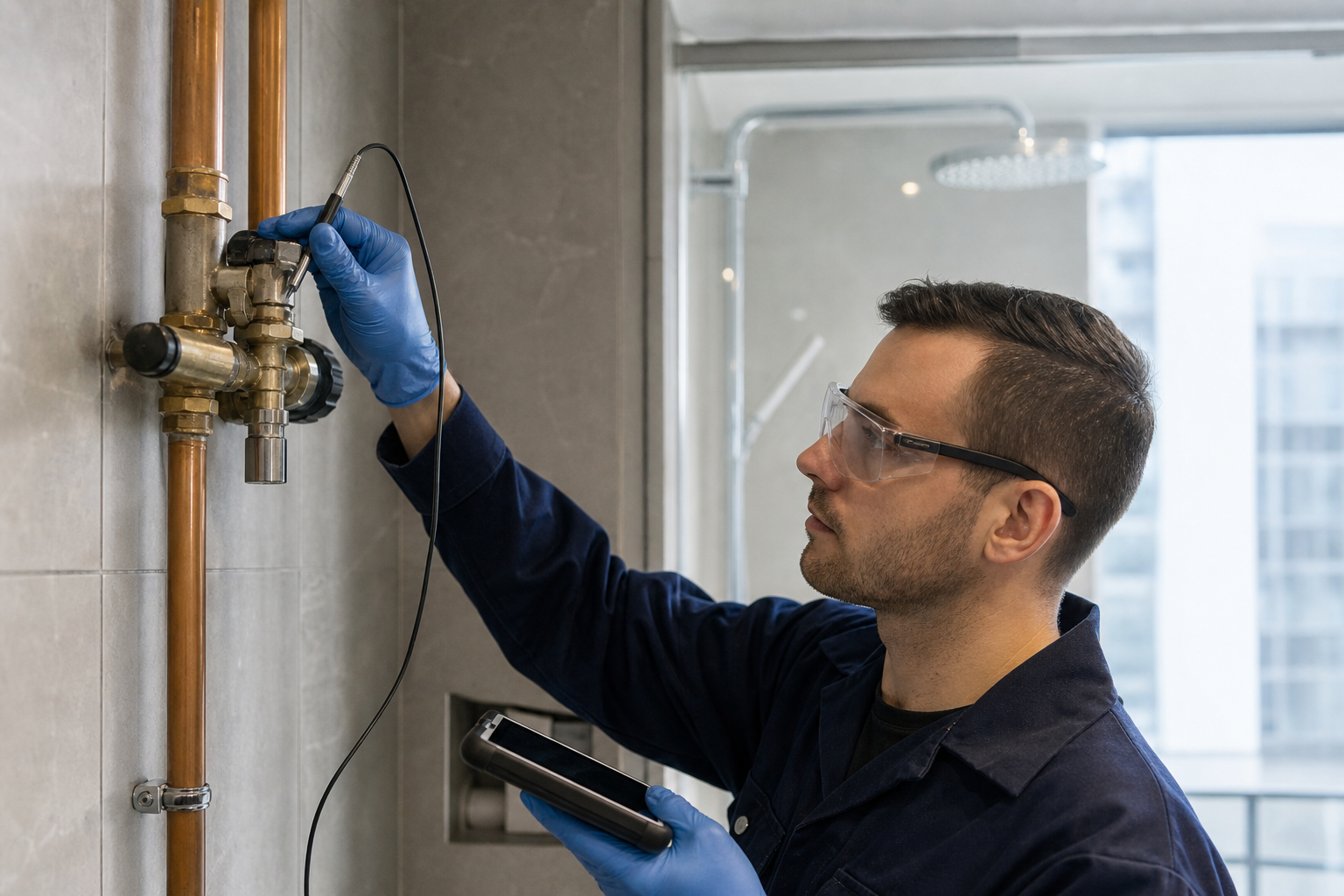
What does a TMV do?
A TMV blends hot and cold water to deliver water at a controlled outlet temperature. This is particularly important where occupants may be vulnerable to scalding. The valve therefore solves one problem at the point of use, but the hot-water supply feeding it still needs to be managed so that the system does not create favourable conditions for Legionella growth.
Why TMVs need to be included in the risk assessment
Mixed water downstream of a TMV may sit at temperatures that are comfortable for users but also fall within the range where bacterial growth can become more favourable. The risk assessment should therefore consider the location of TMVs, the length of mixed-water pipework, outlet use and maintenance arrangements.
Common management mistakes
- Reducing the temperature of the whole hot-water system simply to lower outlet temperature.
- Installing TMVs far from the outlet, creating unnecessary lengths of mixed water pipework.
- Failing to identify little-used TMV-fed outlets.
- Ignoring maintenance, strainers or valve performance.
- Checking only the mixed outlet temperature while overlooking upstream hot and cold temperatures.
- Adding new TMVs during refurbishment without updating the risk assessment.
How should property managers approach monitoring?
The monitoring programme should reflect the design of the building and the control scheme. In many systems, this means checking that the hot-water distribution remains appropriately controlled upstream, the cold-water supply remains sufficiently cool, and the TMV delivers a safe outlet temperature for users.
TMVs in care homes and other vulnerable settings
In care environments, scalding and Legionella risks must be managed together. HSE’s hot-and-cold-water guidance specifically discusses healthcare and care-home systems, including scalding, flushing and monitoring. A competent assessment should avoid solving one hazard by inadvertently increasing another.
When should TMV arrangements be reviewed?
Review is appropriate after refurbishment, changes to hot-water plant, installation of additional TMVs, recurring outlet-temperature problems, long periods of low use, or when the risk assessment no longer reflects the actual system.
For a sector example, see our guide to Legionella Risk in London Care Homes.
Official guidance: Health and Safety Executive (HSE) L8 Approved Code of Practice, HSG274 Part 2, and Legionnaires’ disease: what you must do.
Need a London water-system review? Contact info@londonwatercompliance.com.uk for a site-specific Legionella risk assessment.